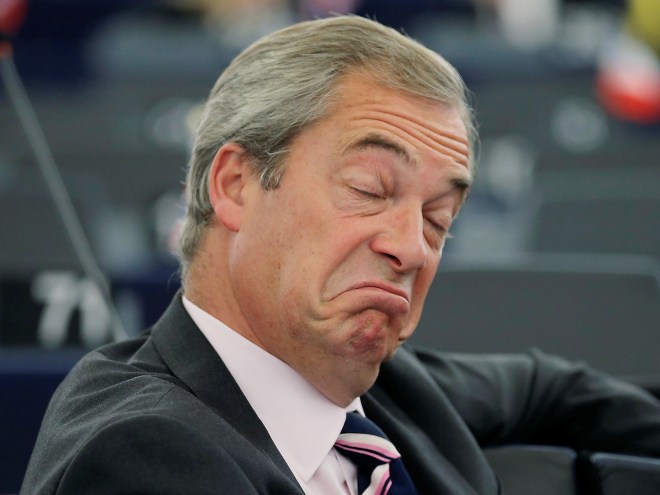
In what we hope will be the first of a series of profiles of the architects of Brexit, we’re going to focus on the man without whom the referendum would probably never have happened: Nigel Farage. What makes him tick and what’s in it for him?
Farage first became the leader of the UK Independence Party (UKIP) in 2006, since when the party has become a major political force in the UK. Farage has consistently peddled a simple message: the UK is weakened by its membership of the European Union, both economically and politically. As time has gone on, this stance has become more and more boiled down to the single issue which has gained most traction with the public: immigration. Free movement of people as imposed by the EU, claims Farage, has damaged the UK by clogging up public services and changing communities. But his opposition to immigration is far from limited to that from the EU, and his tendency to frame the argument in the most basic and often inflammatory terms has made him a controversial figure.
Indeed, during the referendum campaign, the established Out campaign marginalised Farage, who headed the separate Leave.eu campaign. But as polls remained firmly on the side of the Remain camp, Farage was brought more into the limelight as his key theme of immigration was found to be the primary concern for many voters. For the last month or so of campaigning, the focus was on immigration and ‘taking back control’, culminating in Farage’s notorious Breaking Point poster depicting a line of Middle East refugees (again, blurring the lines between EU and non-EU immigration, migrants and refugees). The murder of MP Jo Cox by a right-wing extremist toned down the heat of the debate, but it seemed that for key sections of society, the message had hit home: leave the EU, stop immigration, make everything better.
Of course, like many of the architects of Brexit, Farage is not one to be bothered with details and specifics, so having poked the hornets’ nest and apparently got his wish, he resigned as leader of UKIP, claiming he ‘wanted his life back’. However, he is still wont to pop up at any suggestion that the break with the EU may be anything other than the hardest of hard Brexits, claiming that this would be a ‘betrayal of the will of the people’ – this despite the fact that in the run-up to the referendum, he frequently cited as good examples Norway and Switzerland, countries that pay for membership of the Single Market. “The will of the people” seems to be something that Farage thinks he has aunique insight into – but only the “decent people, ordinary people” who voted to Leave (so what does that make the 48% of us who wanted to Remain?)
Furthermore, not content with realizing the UK’s exit from the EU, he now seems intent on plotting similar exits in other European countries, claiming that he wants “Europe out of the EU”. More recently his ambitions seem to have gone beyond Europe – an intervention in Donald Trump’s successful presidential campaign led for calls for Farage to be made ambassador to the US, calls that he has been only too happy to repeat.
Riding the wave of the twin triumphs of Brexit and Trump, Farage now comes across as a man high on the smell of his own bullshit, even having the temerity to attack the widow of assassinated MP Jo Cox as “knowing more about extremism than me” – the ‘extremist group’ in question being the anti-racist, pro-refugee, community-building Hope Not Hate.
So what drives this apparent antipathy at seeing nation states working together for the common good? I suspect that Farage is simply of a personality type that finds harmony between nations intolerable, and gets an almost mischievous thrill in sowing discord. Perhaps some light can be shed in looking at his youth: as a pupil at Dulwich College in South London, evidence has been found of considerable consternation among the teachers at the young Farage’s behaviour, particularly relating to racism and bullying of other boys. A letter written by a teacher after Farage was made a prefect is particularly damning. Maybe there is something more sinister beneath Farage’s ‘man of the people’, anti-establishment, mischievous trouble-maker act?
 Citizens Of The World